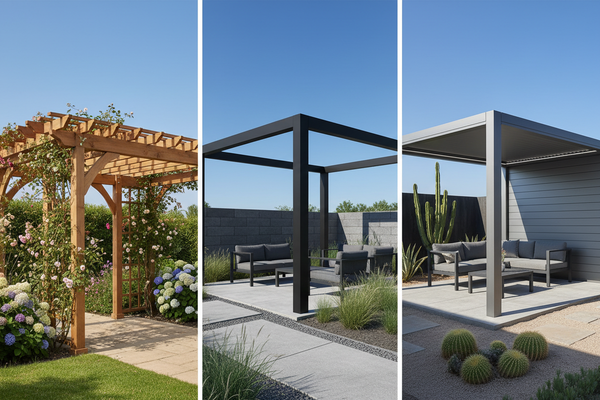
If you've got an open terrace, rooftop, or balcony sitting unused for most of the year because it's either baking in the sun or flooding every monsoon, you've probably already started comparing terrace roofing options. Search "terrace roofing India" and you'll find three answers competing for your attention: the classic tin or asbestos shed, the increasingly popular polycarbonate sheet roof, and the newer aluminium pergola.
Each solves the "cover my terrace" problem differently and each comes with a very different price tag, lifespan, and day-to-day experience. Here's an honest, side-by-side look at all three, so you can pick based on what actually matters for your space: budget, how long you want it to last, and whether you want a functional cover or a space you'll actually want to spend evenings in.
Quick Comparison at a Glance
|
Metal/Tin Shed |
Polycarbonate Sheet |
Aluminium Pergola |
|
|---|---|---|---|
|
Typical cost |
Lowest |
Low–mid |
₹2.5 lakh onwards |
|
Material |
GI sheet / asbestos |
Multiwall polycarbonate |
6063-T6 aerospace-grade aluminium |
|
Lifespan |
5–10 years |
10–15 years (UV-protected grades) |
25–30+ years |
|
Warranty |
Rarely offered |
Sheet manufacturer warranty only |
10 years (frame & coating) |
|
Rain protection |
Good, but noisy |
Good, but heat builds up under direct sun |
100% waterproof when closed, hidden drainage |
|
Ventilation control |
None — fixed roof |
None — fixed roof |
Adjustable louvers — open for airflow, close for rain/sun |
|
Wind resistance |
Depends on installation quality |
Depends on frame quality |
Tested to 120 km/h |
|
Look & feel |
Utilitarian |
Functional, translucent |
Premium, architectural |
|
Maintenance |
Rust, repainting |
Occasional cleaning, sheet yellowing over time |
Maintenance-free |
|
Best for |
Tight budget, storage/utility areas |
Covered parking, budget terrace cover |
Living/entertaining terraces, rooftops, long-term investment |
Option 1: Metal or Tin Shed Roofing
The tin shed (or in older constructions, asbestos sheet) is still the default for a lot of Indian homes simply because it's cheap and fast to put up. A contractor can install one in a day or two, and the upfront cost is the lowest of the three options here.
The trade-offs show up over time. GI sheets conduct heat, so the space underneath gets noticeably hotter in summer. Monsoon rain on a metal roof is loud enough to be genuinely disruptive if the terrace is anywhere near a bedroom. And without a good anti-rust coating, sheets start corroding and staining within a handful of years asbestos sheets, while still sold, also carry well-documented health concerns that many homeowners now actively avoid. It's a reasonable choice for a utility area, storage shed, or a genuinely tight budget less so for a terrace you actually want to use.
Option 2: Polycarbonate Sheet Roofing
Polycarbonate sheet roofing sits a step up from tin: it's translucent (so the space underneath stays bright without being fully exposed), lighter than glass, and reasonably impact-resistant. Multiwall/twin-wall polycarbonate sheets — the kind manufacturers like Coxwell produce for skylights, canopies, and terrace covers — are UV-stabilized to resist yellowing and are a genuinely solid mid-range option, especially for covered parking, side terraces, or spaces where you want daylight without direct sun.
The catch is that it's still a fixed roof. Once it's up, you can't open it for airflow on a pleasant evening or close it tighter during a storm — it's shade and rain cover, full stop, with no ventilation control. On a west-facing or unshaded rooftop, heat can still build up underneath during peak summer afternoons, similar to how a car heats up under sun through glass. It's a solid, cost-effective option for practical coverage — just not built for the sit-outside-and-relax use case.
Option 3: Aluminium Louvered Pergola
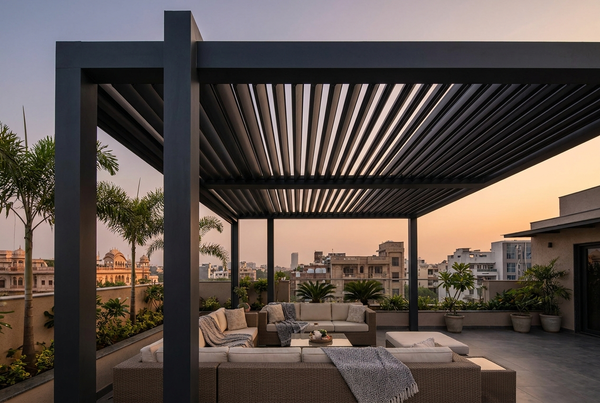
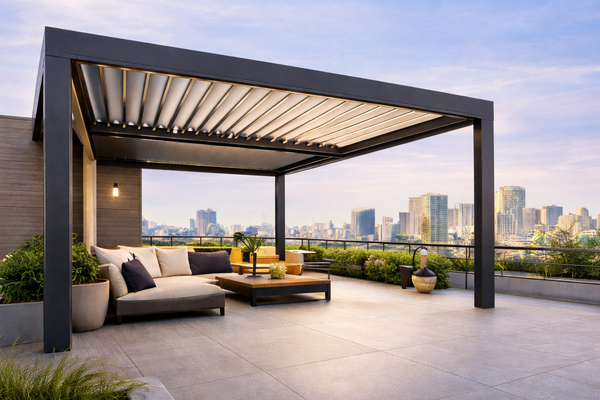
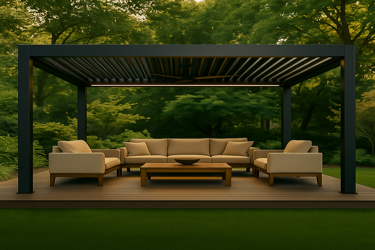
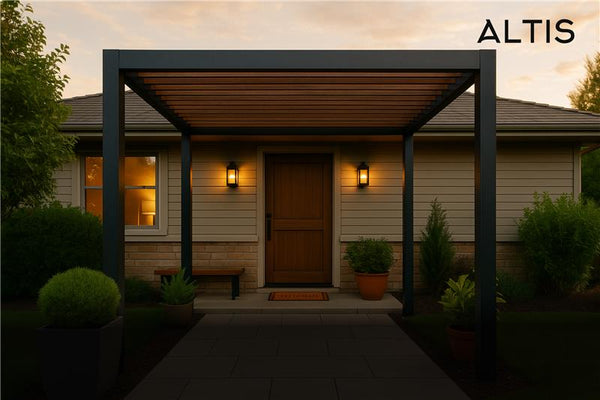
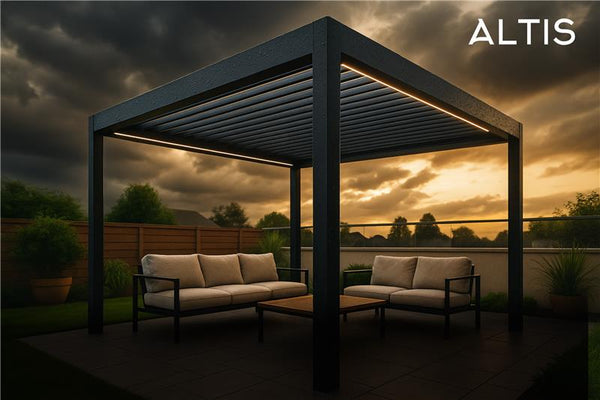
A pergola is a different category of product altogether — not a fixed roof, but an engineered outdoor structure with a louvered aluminium roof you can open or close on demand. Altis Home's pergolas, for example, are built entirely from 6063-T6 aerospace/marine-grade aluminium (frame, posts, beams, and louvers), finished with waterproof outdoor powder coating so they don't rust, warp, or fade the way tin or wood does over time.
The louvers are the real functional difference: rotate them open for shade with airflow on a pleasant evening or close them fully for a 100% waterproof seal rainwater is channeled through hidden internal gutters and drains down through the posts, so there's no visible plumbing and no pooling. The structure itself is independently wind-tested to 120 km/h, with reinforced baseplates, which matters a lot for rooftops and open terraces that catch more wind than a ground-floor space.
Altis pergolas come in two variants: a manual, hand-crank version (single-layer louvers, more budget-friendly, no electricity needed) and a motorized version with remote-controlled louvers, double-layer louvers for better heat insulation, and integrated LED lighting built in as standard. Sizes run from 3×3 m up to 4×6 m (larger spaces can combine two units), assembly takes 2–4 hours as a pre-cut kit, and every pergola carries a 10-year warranty on frame and coating with an expected lifespan of 25–30+ years — versus the 5–15 years you'd typically get from a shed or sheet roof. Pricing starts at ₹2.5 lakh, which is a genuinely different investment bracket than the other two options — but it's also the only one of the three designed to function as a real living space, not just a rain cover.
Which One Should You Actually Choose?
-
Tightest budget, purely functional space (storage, utility area, covered two-wheeler parking): a metal shed does the job.
-
Mid-budget, need daylight and rain cover without ventilation control (side terrace, covered parking, utility courtyard): polycarbonate sheet roofing is a solid, cost-effective middle ground.
-
You want your terrace or rooftop to become a space you'll actually use — for meals, evenings, entertaining, or simply enjoying the outdoors year-round — and you're thinking long-term (10+ years) rather than just covering the space cheaply: an aluminium pergola is built for exactly that, with the adjustability, durability, and warranty to back it up.
Thinking about which option fits your terrace? Altis Home designs and installs aluminium louvered pergolas across Delhi NCR — manual and motorized, in sizes from 3×3 m to 4×6 m, with a 10-year warranty. Reach out at hello@altishome.com or +91-8527577844 for a site-specific recommendation.